
 Mon-Fri 9:00 - 18:00 (GMT+3)


Refinery Catalyst Management: How XRF Analyzers Monitor Platinum and Palladium in Cat Crackers and Reformers
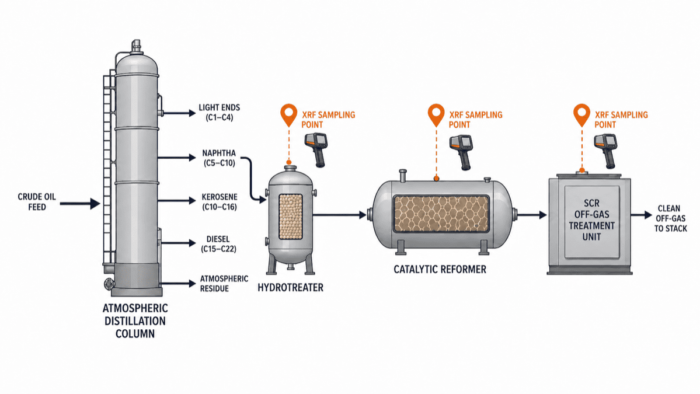
A fluid catalytic cracking unit runs continuously for years. Inside it, several hundred tonnes of catalyst circulate between the reactor and the regenerator, cracking heavy vacuum gas oil into gasoline and diesel. The catalyst contains no platinum — FCC runs on zeolite. But the reformer upstream does. So does the hydrotreatment unit. And the naphtha reformer. Across a mid-size refinery, the total precious metals inventory tied up in catalysts can exceed $50 million.
When that catalyst depletes, the refinery has two options: regenerate it, or replace it. Getting that decision right — not too early, not too late — is where XRF analysis earns its place in catalyst management programs.
What's Actually in Refinery Catalysts
Different process units use fundamentally different catalyst chemistries, and XRF's role in each reflects those differences.
Catalytic reformers convert low-octane naphtha into high-octane reformate and hydrogen. The catalyst is platinum on alumina, sometimes with rhenium, tin, or iridium as promoters. Platinum loading typically runs 0.2–0.4% by weight — not much, but at $32,000+ per troy ounce, the total inventory in a reformer charge is substantial. Deactivation happens through coking, sintering of platinum particles, and poisoning by sulfur or chloride. XRF tracks the platinum and promoter metals directly on spent and regenerated catalyst samples.
Hydrotreating and hydrocracking units use nickel-molybdenum or cobalt-molybdenum catalysts on alumina supports. No platinum, but molybdenum and nickel are both measurable by XRF, and their concentration relative to the support material gives a deactivation indicator. Vanadium and nickel contamination from crude — deposited from heavy feedstocks — is also tracked directly by XRF, since both are classic catalyst poisons.
Three-way catalysts in refinery off-gas treatment, along with selective catalytic reduction (SCR) units for NOx control, contain platinum, palladium, and rhodium. These are the highest precious metals concentration catalyst types in a refinery, and the ones where recovery economics most clearly justify systematic analytical monitoring.
The Economics of Getting the Replacement Decision Right
Catalyst replacement decisions involve two types of error, each costly in a different direction.
Replacing too early means discarding catalyst that still has useful life and paying for fresh charge before you need to. For a reformer holding 50 tonnes of platinum catalyst at even $200/kg, that's $10 million in fresh catalyst plus whatever recovery credit you get from the spent material — and recovery credits for partially deactivated catalyst are significantly lower than for fresh.
Replacing too late means running a unit at suboptimal conversion, burning extra energy to compensate for declining catalyst activity, and potentially damaging downstream equipment if deactivation accelerates. A reformer running 20% below target yield because catalyst monitoring was neglected costs far more than the analytical program that would have caught it.
XRF gives refinery process engineers a quantitative basis for this decision. Platinum content on spent versus fresh catalyst, promoter metal ratios, vanadium and nickel contamination levels — all measurable in minutes on catalyst samples pulled during routine unit checks. The data feeds directly into regeneration scheduling and charge replacement planning.
How XRF Fits Into Catalyst Sampling Programs
Catalyst management in serious refinery operations runs on sampling protocols — periodic pulls from the unit, characterization of the sample, comparison against a baseline of fresh catalyst and prior sampling history.
XRF fits into this workflow at two points:
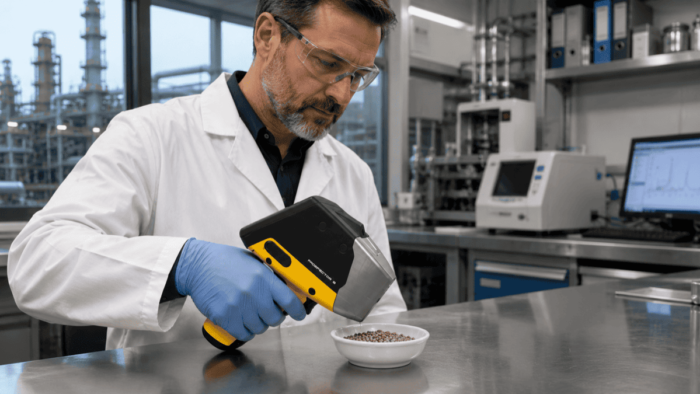
On-site rapid screening during catalyst loading, unloading, or during unit turnarounds. A portable XRF analyzer gives the field team immediate confirmation of precious metals content before the spent catalyst leaves the unit. This matters both for accurate inventory accounting and for preventing accidental loss or misdirection of high-value material.
Laboratory verification on a sub-sample of each batch, using benchtop XRF or ICP-OES for higher precision. The portable XRF on-site screen and the lab verification together give you operational speed plus analytical confidence for the records that govern precious metals accounting with the refiner.
For both applications, the elements that matter most are measurable directly by XRF without sample destruction: platinum (Pt), palladium (Pd), rhodium (Rh), rhenium (Re), molybdenum (Mo), nickel (Ni), vanadium (V), and the alumina support's aluminum (Al) content. Iron, copper, and sodium contamination — all common catalyst poisons — are also in range.
Precious Metals Recovery: Closing the Loop
Spent catalyst isn't waste — it's a recoverable precious metals feedstock. The platinum, palladium, and rhodium in a refinery's spent catalyst stream have real market value, and the difference between a well-documented, carefully segregated spent catalyst lot and a mixed, poorly characterized one can be substantial in the pricing a refinery receives from a secondary refiner.
XRF is the tool that makes that documentation credible. Before spent catalyst goes to a precious metals refiner, characterization of platinum and palladium content — even at the screening level of accuracy that portable XRF provides — gives the refinery a basis for negotiating recovery contracts and verifying that the secondary refiner's assay aligns with what was shipped.
For Gulf Coast refineries dealing with multiple secondary refiners on different streams, and for Latin American refiners in Brazil, Mexico, and Colombia where precious metals refining infrastructure is less developed and shipments may go overseas, that documentation trail matters for both commercial negotiations and regulatory compliance.
Premium portable XRF analyzers in the $35,000–$50,000 range provide the sensitivity needed for precious metals at the concentrations found in reformer and three-way catalyst applications. For the highest precision — particularly for rhodium, which is present at lower concentrations and commands the highest unit price — benchtop instruments in the $30,000–$80,000 range give tighter accuracy. Both options cost a fraction of the precious metals value they're helping to track and recover.
Vanadium and Nickel Contamination: The Other Side of Catalyst XRF
Precious metals depletion gets most of the attention in catalyst management discussions, but contamination monitoring is equally important and equally straightforward with XRF.
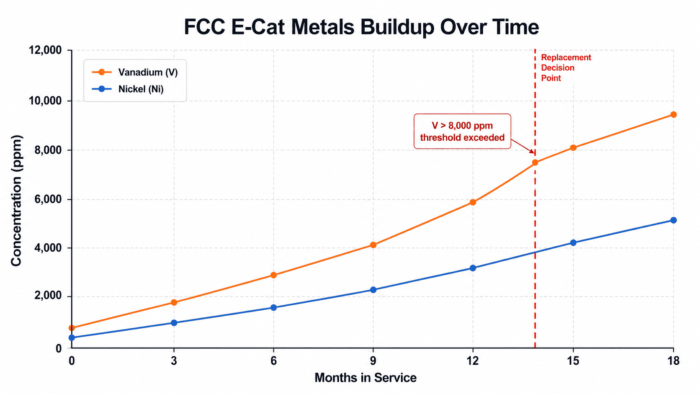
Vanadium and nickel enter FCC and hydroprocessing catalysts from crude feedstock — both are concentrated in residual fractions of heavy crudes, particularly those from Venezuela, Mexico's heavy fields, and some Brazilian pre-salt streams. They poison catalyst selectively: vanadium attacks the zeolite structure, nickel promotes unwanted dehydrogenation reactions and increases hydrogen and coke make.
Tracking vanadium and nickel buildup on equilibrium catalyst (e-cat) from an FCC unit gives process engineers early warning of feedstock changes that are affecting catalyst performance. XRF on e-cat samples pulled from the unit daily or weekly provides that tracking at a cost per test measured in cents, not dollars.
For Latin American refineries processing heavy domestic crudes with high metals content — PDVSA's Orinoco belt crudes, for example, or Mexico's Maya blend — this monitoring is not optional. Catalyst metals loading determines regeneration frequency, catalyst addition rates, and ultimately the unit's ability to run at plan.
Building an XRF-Based Catalyst Monitoring Program
A functional program for a mid-size refinery typically covers three elements:
Sampling discipline. Catalyst samples need to come from representative locations — not just the top of the bed, not just the discharge stream. Sampling protocols vary by unit type; what matters is consistency so that trend data is meaningful.
Reference standards and calibration. Catalyst matrices — alumina-supported, silica-supported, zeolitic — each present slightly different XRF analysis conditions. Validated reference standards matching the catalyst type give the analyzer's calibration a firm basis. Most catalyst suppliers can provide spent and fresh reference material for this purpose.
Data management. XRF results export automatically to CSV or PDF. Building a simple database — unit, sample date, Pt/Pd/V/Ni readings, comparison to baseline — turns individual measurements into the trend data that actually drives decisions. This doesn't require sophisticated software; a structured spreadsheet updated after each sampling event gives refinery engineers everything they need.
The combination of on-site portable XRF screening and periodic laboratory confirmation gives a refinery the analytical visibility to run catalyst charges to their economic optimum — neither replacing early nor running units degraded — while maintaining the documentation needed for precious metals recovery accounting.
FAQ
Can portable XRF accurately measure platinum at the concentrations found in reformer catalysts?
Yes. Platinum at 0.2–0.4% by weight in alumina-supported catalyst is well within the detection and quantification range of premium portable XRF analyzers. For the lowest concentrations or highest-precision requirements — particularly rhodium — benchtop XRF or ICP-OES confirmation is recommended.
How does XRF handle the alumina matrix in catalyst samples?
Alumina (Al₂O₃) is the most common catalyst support material. Modern XRF analyzers handle this matrix well with appropriate calibration. Sample preparation — grinding to a consistent particle size and pressing into a pellet or cup — improves accuracy and reproducibility significantly compared to measuring loose catalyst beads directly.
What's the difference between using XRF for fresh, spent, and regenerated catalyst?
Fresh catalyst establishes the baseline precious metals loading. Spent catalyst shows depletion and contamination buildup after service. Regenerated catalyst confirms that the regeneration process has restored precious metals dispersion and removed coke without loss. Comparing all three gives the complete picture needed for replacement and recovery decisions.
Is XRF suitable for FCC equilibrium catalyst (e-cat) monitoring?
Yes, particularly for vanadium and nickel contamination tracking, which are the primary deactivation mechanisms in FCC. Precious metals are not present in standard FCC catalyst, but the metals contamination monitoring application alone justifies XRF in most FCC catalyst management programs.
How does XRF data feed into precious metals recovery accounting?
Portable XRF provides screening-level data for inventory and shipment documentation. Secondary refiners will conduct their own certified assay on receipt, which governs payment. The XRF data gives the refinery an independent verification basis for checking that the refiner's assay is consistent with what was shipped — important for dispute resolution and long-term commercial relationships.
What accuracy can refineries expect from portable XRF on catalyst samples?
For major elements at typical catalyst concentrations — platinum at 0.2%+, molybdenum at 10%+, vanadium and nickel above 0.1% — premium portable XRF analyzers achieve ±0.05–0.15% accuracy. For trace precious metals below 0.1%, benchtop instruments or ICP-OES provide better detection limits.
Catalyst management isn't glamorous refinery work. It happens in the margins of production schedules, in sampling rooms and analytical labs, in spreadsheets that track metal loading over years of unit operation. But the economics are real: a $50 million precious metals inventory deserves more than eyeball inspection and gut feel about when to replace a charge. XRF gives refinery process engineers the quantitative data to make those decisions on evidence — and to capture the full value of the metals when the catalyst comes out.
If you're building or auditing a catalyst monitoring program, Elvatech can help match the right analyzer configuration to your unit types and analytical requirements. Contact us for a technical consultation.


