
 Mon-Fri 9:00 - 18:00 (GMT+3)


From Mine to Smelter: XRF Quality Control Across the Ore Processing Value Chain
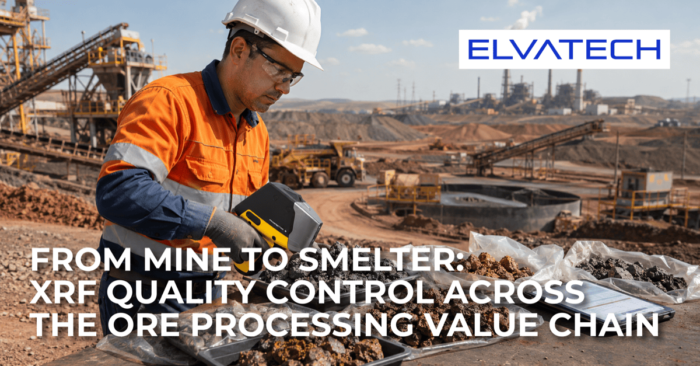
Getting ore out of the ground is only the beginning. Between the blast hole and the smelter furnace, the material passes through a dozen hands and a dozen decisions — each one carrying financial consequence. Crushing, grinding, flotation, thickening, drying, shipping. At every stage, the composition of the material changes. At every stage, someone needs to know what they're actually working with.
Portable XRF analyzers have become the quality control backbone of ore processing operations across Africa and Latin America. Not because they replace laboratory analysis, but because they make the decisions between lab samples faster, better informed, and less expensive. Here's how that works in practice, stage by stage.
Why Ore Processing Needs Continuous Composition Data
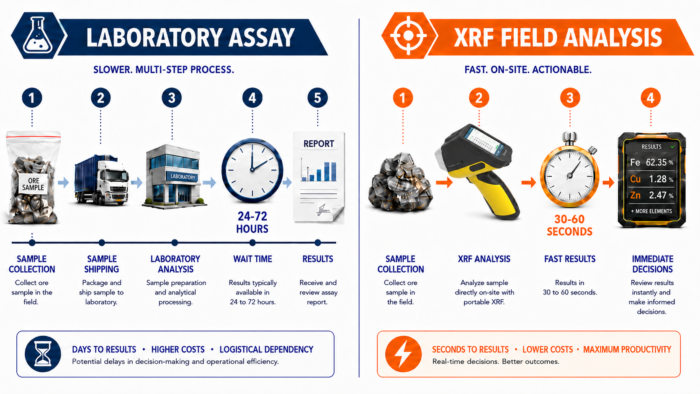
Traditional quality control in mining relies on sampling. Take a split, ship it to the lab, wait 24–72 hours for results. Then make a decision.
The problem: the material you sampled is long gone by the time you get the answer. The flotation circuit is running at whatever settings someone chose this morning. The concentrate drum is full. The truck is loaded. Decisions were made without data.
For copper operations in Peru or DRC, for gold processing in Ghana or Mali, for zinc operations in Bolivia or Zambia — the economics are tight enough that running on yesterday's lab data costs real money. Grade variability in the feed changes optimal flotation reagent dosing. Knowing it in real time matters.
XRF analyzers don't eliminate laboratory analysis. They compress the time between sampling and decision-making from days to minutes.
Stage 1: Run-of-Mine Ore and Crusher Feed
The first control point is at the crusher. Run-of-mine ore from different parts of the pit or underground workings can vary significantly in grade — and in penalty element content. An XRF analyzer at the crusher lets operators characterize incoming material before it enters the circuit.
For a copper-gold operation, this means checking whether a batch of ore is ore-grade or waste before it consumes crushing energy. For processing plants buying ore from multiple small-scale miners (common across parts of West Africa and the Andes), it provides a fast, credible basis for purchase price determination.
The typical protocol: sample collection at the conveyor or stockpile, measure a prepared split with the XRF, get elemental percentages in 30–60 seconds. High-grade ore to the primary circuit. Low-grade material to a stockpile for later processing or rejection. The decision made with data, not estimation.
What the XRF reads at this stage: copper (Cu), gold (Au) if grades are sufficient for XRF detection, iron (Fe), sulfur (S), and penalty elements like arsenic (As), lead (Pb), and zinc (Zn) that affect both processing efficiency and concentrate marketability.
Stage 2: Grinding Circuit Control
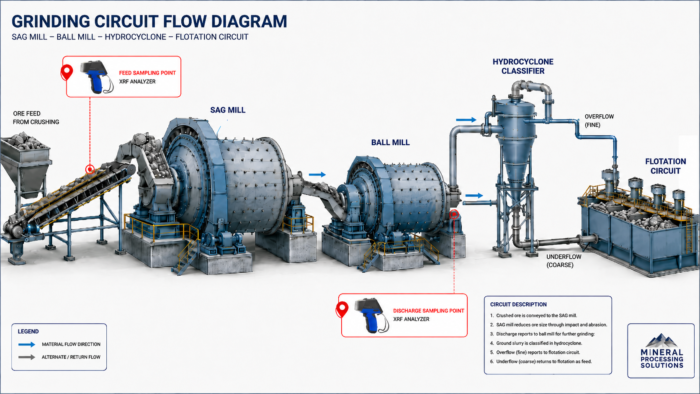
After crushing, ore goes to grinding — typically a SAG mill or ball mill circuit reducing particle size to the 75–150 micron range where liberation occurs. The goal is to grind fine enough that valuable minerals separate cleanly from gangue, but not so fine that energy is wasted or fine particles are lost.
At the grinding stage, XRF provides feed grade verification and discharge grade checking. If the mill feed grade drops significantly — indicating a change in the ore being processed — operators can adjust parameters proactively rather than discovering the change when flotation recoveries drop two hours later.
For polymetallic operations processing copper-molybdenum ores (common in Chile and Peru) or copper-zinc-lead ores (common in Central Africa), knowing the multi-element composition of mill discharge helps predict flotation behavior and adjust reagent scheme accordingly.
Stage 3: Flotation Circuit — The Critical Stage
Flotation is where most of the money is made or lost. Reagent addition — collectors, frothers, modifiers, pH adjustment — has to be calibrated to the actual ore composition coming through. Wrong reagent scheme means poor recovery. Or contamination between concentrates in selective flotation.
XRF analyzers are used in flotation control in two ways:
Rougher concentrate grade checking: Pull a sample from the rougher concentrate launder, prepare it quickly, run the XRF. Is copper recovery where it should be? Is iron contamination in the copper concentrate within acceptable limits? This check can run every 30 minutes during a shift.
Cleaner circuit monitoring: The cleaner circuit upgrades rougher concentrate to final saleable grade. If XRF shows the cleaner concentrate is running below target grade — say 25% Cu when the spec calls for 28% — operators have time to adjust before the shift ends. Not after.
For gold operations using gravity circuits alongside flotation, XRF on the concentrate gives a real-time grade estimate that feeds into daily accounting. Not at the precision of fire assay, but accurate enough for shift decisions.
Stage 4: Final Concentrate Quality and Export Compliance
The concentrate leaving a mine site has to meet buyer specifications. Those specifications are legally binding. Ship a copper concentrate with 0.3% arsenic when the buyer allowed 0.2%, and you're looking at penalties, rejection, or in some cases, return of the cargo at your cost.
Concentrate buyers — smelters in China, Japan, Germany, India — assay every shipment on arrival. Their numbers govern payment. If your numbers and their numbers disagree significantly, you have a problem.
XRF on final concentrate serves two purposes. First, rapid verification before the material leaves the site — a final check against specifications before loading begins. Second, generating documentation that supports your position in the case of disputes.
The elements that matter for concentrate specifications and penalty clauses typically include:
- Copper (Cu): Minimum grade threshold (typically 20–30%)
- Iron (Fe): Indicator of gangue contamination
- Sulfur (S): Affects smelting efficiency, may carry penalties
- Arsenic (As), bismuth (Bi), antimony (Sb): Penalty elements with strict limits in most smelter contracts
- Lead (Pb), zinc (Zn): Penalty or credit elements depending on the contract
All of these fall within the detection range of portable XRF analyzers. For gold and silver credits — the payable elements beyond copper — XRF gives indicative values that should be confirmed by fire assay for contract purposes, but XRF is accurate enough for operational decisions.
Stage 5: Dry Stack and Tailings Management
Increasingly, regulators in Chile, Peru, South Africa, and across sub-Saharan Africa are requiring detailed characterization of tailings storage facilities. What's in the tailing? What are the acid-generating sulfide concentrations? What heavy metals are present above regulatory thresholds?
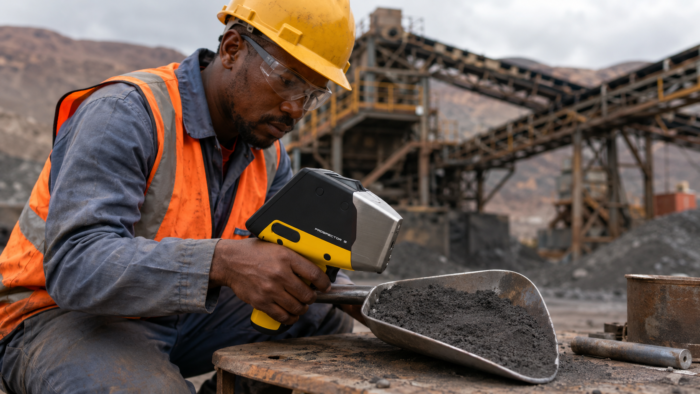
This isn't just environmental compliance. It's also a resource question. Tailings from old operations often contain recoverable metals that weren't extractable with older technology. XRF on tailings material gives a fast grade profile across a large area — information that informs both remediation planning and potential retreatment economics.
XRF soil analysis protocols, adapted for tailings material, can cover large areas quickly. A single operator with a portable analyzer can characterize dozens of sample points in a day — far faster and cheaper than batch laboratory analysis.
Integrating XRF Data into the Processing Operation
A portable XRF analyzer doesn't live in a vacuum. Data from shift-by-shift measurements feeds into process decisions. Over time, that data builds a picture of ore variability, reagent response, and concentrate grade trends that laboratory analysis — at its slower cadence — can't provide.
Most modern XRF analyzers store test results with timestamps, GPS coordinates, and sample IDs. Export to CSV, XML, or PDF is automatic. That data integrates directly into shift reporting, concentrate accounting systems, and mine planning software.
For operations with multiple sampling points — crusher feed, mill discharge, rougher concentrate, final concentrate — the combination of XRF and periodic laboratory assay creates a complete analytical picture. XRF provides the high-frequency operational data. The lab provides the high-accuracy calibration reference.
Mid-range portable XRF analyzers in the $25,000–$35,000 range are the standard choice for ore processing quality control — durable enough for plant environments, fast enough for shift-level decision cycles. Operations with high sample volumes and demanding accuracy requirements often move to premium analyzers with SDD detectors, which provide better separation of overlapping elemental peaks in complex multi-element concentrates.
FAQ
-
Can XRF measure gold grades accurately enough for ore processing decisions?
At typical ore grades (0.5–5 g/t), gold concentrations are below the reliable detection limit of portable XRF. XRF is more useful for gold in concentrate (hundreds of grams per ton) where concentrations are high enough for accurate measurement. At ore grades, fire assay remains the standard. -
How do you handle the particle size effect on XRF readings?
XRF accuracy improves with finer, more homogeneous samples. Crushed or ground material gives better readings than coarse lumps. Standard practice is to split, dry, and ideally press samples into pellets for the most accurate results. For screening purposes, a cup of crushed material gives usable results. -
What penalty elements does XRF detect in concentrates?
Arsenic, bismuth, antimony, lead, and zinc are all detectable, along with fluorine and chlorine when the analyzer is configured for light elements. Detection limits vary by element and matrix, so it's best to consult your XRF supplier for method validation data specific to your concentrate type. -
How does XRF accuracy compare to laboratory ICP for concentrate analysis?
Premium portable XRF analyzers achieve roughly ±0.05–0.15% accuracy on major elements like copper in concentrate. Laboratory ICP achieves around ±0.01% or better. For most processing decisions, XRF accuracy is sufficient. For final contract assay and payment calculations, laboratory analysis remains the reference standard. -
Can the same XRF analyzer be used for both ore and concentrate analysis?
Yes, with appropriate calibration modes for each matrix. Most portable XRF analyzers support multiple calibration methods: mining or soil modes for ore analysis, and alloy or fundamental parameters modes for concentrate. Confirm with your supplier that your analyzer supports the specific matrix calibrations you need. -
Is portable XRF suitable for very remote locations in Africa or the Andes?
It's built for exactly that kind of use. IP-rated construction, 8-10 hours of battery operation between charges, temperature tolerance from -10°C to 50°C, and minimal maintenance requirements make portable XRF analyzers well suited to remote operations where the nearest laboratory might be 200 kilometers away.
Ore processing is a series of decisions made under time pressure with incomplete information. XRF doesn't make those decisions — experienced metallurgists and process operators do. But it gives them real composition data at the frequency their decisions actually require. That's the difference between process control and educated guessing.
For copper, zinc, lead, gold, and polymetallic operations across Africa and Latin America, the investment in portable XRF analysis at key process points typically returns its cost within the first year through improved recoveries, reduced penalties, and faster response to ore variability. Contact Elvatech to discuss the right analyzer configuration for your processing circuit.


