
 Mon-Fri 9:00 - 18:00 (GMT+3)


Infrastructure Boom in Africa: XRF Alloy Analyzers as Quality Assurance Tools on Mega-Projects
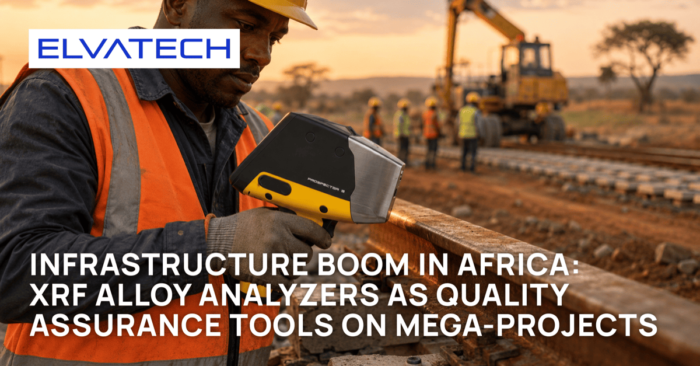
A railway sleeper made from substandard steel doesn't fail on the day it's installed. It fails three years later, under a loaded freight train, after enough fatigue cycles have accumulated. By then, the contractor who supplied the steel is long gone, the project has been handed over, and the liability question is complicated. The only way to prevent that outcome is to verify the material before it goes into the ground — not after.
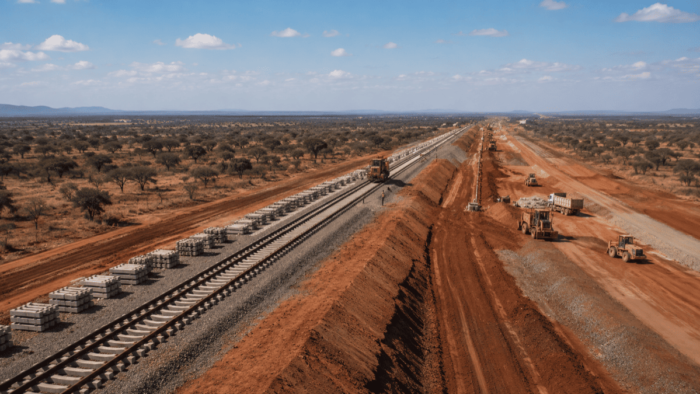
Africa's infrastructure buildout is running at a scale that makes material verification simultaneously more critical and more logistically difficult than almost anywhere else on earth. Projects spanning hundreds of kilometers, remote construction sites hours from the nearest certified laboratory, supply chains sourcing from multiple mills across three continents — these are the conditions under which x ray alloy analyzers have become standard equipment for serious QA programs.
The Scale of the Problem: What's Being Built
The numbers are worth stating plainly. The Standard Gauge Railway in Kenya runs 480 kilometers from Mombasa to Nairobi, with extensions pushing toward Uganda and beyond. The Grand Ethiopian Renaissance Dam on the Blue Nile is one of the largest hydroelectric projects on the continent. Port expansions at Dar es Salaam, Nacala, and Maputo are reshaping East Africa's logistics infrastructure. Road networks, bridges, power transmission lines, water treatment plants — the pace of construction across sub-Saharan Africa has no precedent in the region's history.
Chinese and Turkish contractors dominate much of this work, operating under tight schedules and project economics that put pressure on every link in the supply chain. Steel, rebar, structural sections, fasteners, pipe — vast quantities sourced from mills in China, Turkey, India, and increasingly from South African and East African producers. Each supply chain link is an opportunity for substitution, mislabeling, or outright fraud.
Counterfeit and Substandard Materials: A Real and Documented Problem
Counterfeit construction materials aren't a theoretical risk in the African infrastructure context — they're a documented operational problem. Steel rebar labeled as Grade 60 (yield strength 420 MPa) but actually meeting Grade 40 specifications. Structural sections stamped with mill certificates from reputable producers but manufactured to lower specifications. Fasteners with hardness grades marked on the head that don't correspond to the actual metallurgy.
The problem concentrates at specific points in the supply chain: at commodity trading intermediaries who repackage material, at smaller distributors who source opportunistically, and in project conditions where procurement pressure is high and inspection resources are stretched thin. A large project buying millions of tonnes of steel creates exactly the procurement environment where substitution risk is highest.
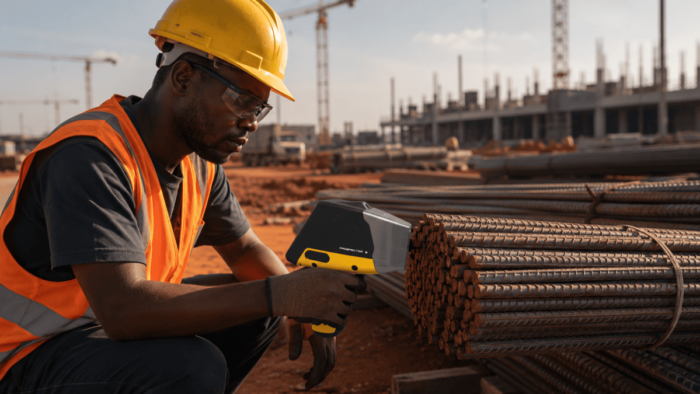
An x ray alloy analyzer closes this gap at the point where it matters — incoming material inspection at the project site. A rebar sample takes 3–5 seconds to grade. A structural section takes the same. The inspector gets a full elemental composition: carbon equivalent (calculated), manganese, silicon, sulfur, phosphorus — everything that determines whether the steel will perform to specification under load, fatigue, and in the case of seismic zones, under dynamic loading.
How XRF Alloy Analysis Works on a Construction Site
The practical workflow on a large infrastructure project typically runs at two points:
Receiving inspection at the laydown yard. Before any material leaves the laydown area for the construction front, a sample from each delivery lot is checked against the purchase specification. Carbon steel rebar? Confirm the carbon equivalent and manganese content that determine weldability and yield. Structural steel sections? Verify the grade against the relevant standard — EN 10025, ASTM A36, Chinese GB/T 700, depending on the project's specification basis. High-strength fasteners? Check alloy content against the grade marking.
Pre-installation spot checks. Even material that passed receiving inspection can get mixed up in a large laydown yard with hundreds of deliveries over months. Spot checks immediately before installation — particularly for critical elements like bridge beams, dam penstock components, or railway turnout structures — provide a final verification that what's being installed matches the design specification.
Both workflows fit the pace of a large construction project. The alloy analyzer moves with the inspector, not the other way around.
Project-Specific Applications
Kenya Standard Gauge Railway. The SGR project involved steel rails, structural steel for bridges and stations, rebar for civil works, and fasteners by the millions. The rail itself — typically to UIC 60 or equivalent specification — requires tight carbon and manganese control for wear resistance and weldability. A thermite weld between two rail sections with mismatched metallurgy creates a weak point that cycling wheel loads will find eventually.
Grand Ethiopian Renaissance Dam. The dam's penstock pipes, turbine components, and structural steel operate under conditions — high pressure, cyclic loading, wet environment — where material specification compliance is directly tied to operational safety. The project's scale (involves billions of dollars in steel and mechanical equipment) creates exactly the procurement volume where substitution risk concentrates.
East African ports (Dar es Salaam, Nacala, Maputo). Port infrastructure involves structural steel piling, marine-grade fasteners, crane structures, and quay wall reinforcement — all in aggressive chloride environments where the difference between specified and actual corrosion resistance determines maintenance cycles and structural life. Material substitution that shows up as inadequate corrosion resistance in a port environment is expensive to remediate after the fact.
Sub-Saharan power infrastructure. Transmission tower steel, substation structural components, and transformer copper windings are all verifiable by XRF alloy analysis. Tower steel in particular is frequently sourced through commodity channels where substitution risk is elevated.
The Chinese and Turkish Contractor Context
Understanding why material verification matters specifically in this procurement environment requires understanding how major Chinese and Turkish contractors actually operate on African mega-projects.
Both typically bring their own procurement teams and source significant material volumes directly from home-country mills, supplemented by local sourcing where logistics make it efficient. The home-country mill supply is generally well-documented and traceable. The supplemental local sourcing — particularly for commodity items like rebar, structural steel, and fasteners bought through local traders and distributors — is where the verification gap opens up.
Reputable contractors in this space have built incoming inspection protocols that include XRF alloy verification specifically because their project experience in Africa has taught them that the local commodity market cannot be trusted on specification compliance alone. The cost of the alloy analyzer and the inspection program is trivial against the liability exposure of installing substandard structural steel in a bridge, a dam, or a railway that will carry passengers for fifty years.
Documentation: The Second Half of the QA Program
Catching a substandard material delivery is one thing. Documenting it — with timestamped analytical data, sample identification, and clear comparison against specification requirements — is what turns a field inspection into a contractual record.
Modern portable XRF alloy analyzers export results automatically to CSV, XML, or PDF with timestamps and sample IDs. On a project with hundreds of material deliveries over a multi-year construction schedule, that documentation becomes the project's material compliance record. It protects the main contractor against liability for substandard materials supplied by subcontractors. It protects the project owner against receiving non-compliant infrastructure. And it protects the local regulatory authority that ultimately signs off on the project.
Mid-range portable XRF analyzers in the $25,000–$35,000 range handle the full scope of construction steel and structural alloy verification. For projects working with specialty alloys — stainless steel components in water treatment plants, duplex grades in coastal port structures — premium analyzers with SDD detectors in the $35,000–$50,000 range provide better resolution on the grade distinctions that matter.
FAQ
Can XRF verify carbon content in structural steel?
Carbon is a light element that falls outside the standard XRF detection range. XRF cannot measure carbon directly. However, it measures all the alloying elements — manganese, silicon, chromium, molybdenum, vanadium — that define steel grade and calculate carbon equivalent. For most structural steel verification purposes, the alloying element profile is sufficient to confirm grade compliance. Carbon content confirmation requires OES (optical emission spectrometry) or combustion analysis.
How does XRF handle mill scale and surface contamination on rebar?
Surface contamination affects XRF readings. Standard protocol is to clean a small area of the rebar surface — wire brush or grinder removes mill scale — before measuring. This takes 30 seconds and significantly improves accuracy. For incoming inspection where throughput matters, one cleaned spot per bar is standard practice.
Is portable XRF accurate enough to distinguish between close steel grades?
For most structural steel grades used in African infrastructure projects — distinguishing Grade 40 from Grade 60 rebar, or S275 from S355 structural sections — yes, portable XRF provides sufficient accuracy. The manganese and silicon content differences between these grades are resolvable. For very close high-alloy grades where tight tolerances matter, laboratory OES confirmation is recommended.
What international standards apply to material verification on African infrastructure projects?
This varies by project. Chinese-funded and Chinese-contracted projects typically reference Chinese GB standards alongside international ones. World Bank and African Development Bank-funded projects often require ASTM or EN standards. Most large projects specify multiple acceptable standards. The XRF verification protocol should reference whichever standard governs the specific material specification.
Can one XRF analyzer cover all the material types on a large infrastructure project?
Yes. A single mid-range portable XRF analyzer covers carbon steel, stainless steel, aluminum alloys, copper alloys, and high-strength fasteners — all the material types typically encountered on an infrastructure project. Different calibration modes handle different material families; modern analyzers switch between them automatically based on what the detector reads.
How do contractors handle XRF verification results that don't match mill certificates?
The standard response is to quarantine the non-conforming lot, notify the supplier, and require either replacement material with verified compliance or an independent laboratory test of the disputed material. The XRF result is the trigger for action, not necessarily the final arbiter — but it's what converts a vague concern about material quality into a specific, documented non-conformance.
Africa's infrastructure moment is real, and so is the quality gap that runs through it. The projects being built today will carry freight, generate power, and move people for generations. The steel going into those projects deserves the thirty seconds of verification that an x ray alloy analyzer takes. The contractors, project owners, and regulators who understand that are building it into their procurement and inspection workflows. The ones who don't are building in liability.
Elvatech's portable XRF analyzers are used in infrastructure QA programs across multiple continents. If you're building a material verification program for a large project, contact our team to discuss the right configuration for your material types and inspection volume.


