
 Mon-Fri 9:00 - 18:00 (GMT+3)


Midstream Pipeline Integrity: PMI XRF Verification in Latin America
A drilling rig in Vaca Muerta doesn't wait for paperwork. By the time a mill certificate gets matched to its corresponding joint of pipe, the crew may have already welded fifty more joints further down the right-of-way. This is the central problem with material verification on large midstream projects: the pace of construction outruns the pace of documentation, and that gap is exactly where the wrong material gets installed.
PMI XRF testing exists to close that gap in real time, on-site, without slowing the crew down. Across Argentina's Vaca Muerta shale play, Brazil's pre-salt gathering systems, and Venezuela's aging and contested pipeline network, the specific risks differ — but the underlying need is the same: verify what's actually going into the ground, not just what the paperwork says should be there.
Why Midstream Projects Are a Different Verification Problem
A single offshore platform might involve thousands of individual fittings, valves, and flanges — a large but bounded population. A gathering pipeline system in Vaca Muerta can run hundreds of kilometers, installed by multiple contractor crews working simultaneously, sourcing pipe and fittings from several mills and suppliers under time pressure to hit drilling schedules.
That scale changes the verification math. You're not inspecting every joint individually with lab-grade scrutiny. You're running statistical sampling across a moving construction front, verifying incoming material at the pipe yard, and spot-checking installed sections during tie-ins and crossings. A 30-second PMI XRF check fits into that workflow. A multi-day lab assay does not.
The consequence of getting this wrong scales with the project too. A single wrong fitting on one platform is a contained problem. A systematic material substitution across 50 kilometers of pipeline — caught only after a leak, a pressure test failure, or a regulatory audit — is a different order of cost and reputational damage entirely.
What PMI XRF Can — and Can't — Verify on Line Pipe
This is worth being precise about, because overclaiming here creates real risk.
Line pipe under API 5L is graded primarily by mechanical strength — X42 through X80 and beyond — achieved largely through microalloying with elements like niobium, vanadium, and titanium, combined with controlled rolling and cooling during manufacture. Carbon content matters enormously to the final mechanical properties, but carbon is a light element that falls below the reliable detection range of standard XRF analyzers.
What this means in practice: PMI XRF on line pipe can confirm the presence and approximate concentration of microalloying elements (Nb, V, Ti, Mn, Cr, Mo, Cu, Ni) and catch gross errors — wrong alloy family entirely, a carbon steel substituted where a low-alloy grade was specified, a stainless fitting mixed into a carbon steel run. It cannot, by itself, confirm that a joint marked X70 actually meets X70 yield strength. That confirmation comes from mill certification and, where verification is critical, mechanical testing.
Where XRF earns its place unambiguously on midstream projects is everywhere stainless and alloy steel fittings, valves, and flanges enter the system — pig launchers and receivers, valve bodies, instrumentation connections, and any location where corrosion resistance requirements push the specification toward 304, 316, or duplex grades. Here, XRF does exactly what it does on any other PMI application: confirms grade with confidence in seconds.
The practical approach: use PMI XRF for alloy and fitting verification everywhere it applies cleanly, and pair it with mill certificate cross-referencing — not substitution for it — on carbon and low-alloy line pipe where strength grade is the real specification driver.
Vaca Muerta: Speed and Remoteness
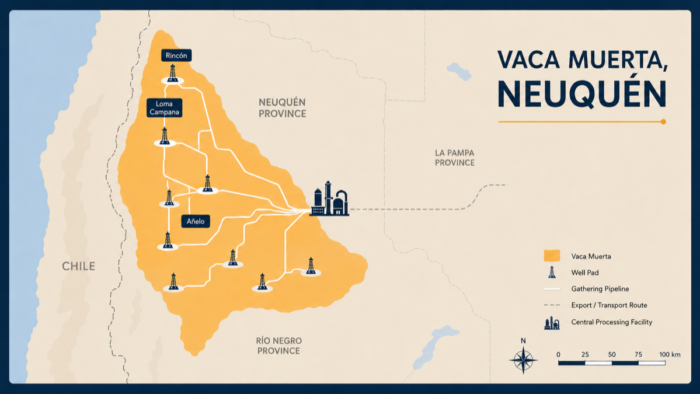
Argentina's Vaca Muerta shale formation has driven a sustained buildout of gathering and gas transport infrastructure across Neuquén province — remote, arid terrain where the nearest accredited lab might be hours away by truck.
The construction pace here is aggressive. Pipeline crews move with the drilling schedule, and gathering lines connecting new wells to processing facilities get built in compressed timeframes. Contractors managing multiple simultaneous spreads need verification that doesn't become the bottleneck.
PMI XRF screening at the pipe yard — before material moves to the right-of-way — catches mismatched deliveries before they're welded into the ground. For fittings and valve assemblies sourced from multiple suppliers under pressure to meet delivery schedules, a quick grade check at receiving is far cheaper than excavating a buried section months later.
Brazil's Pre-Salt: Onshore Tie-Ins to Offshore Production
Brazil's pre-salt fields are mostly known for deepwater production, but the onshore receiving terminals, gathering systems, and export pipelines that connect FPSOs to processing and distribution infrastructure represent significant midstream construction in their own right.
These onshore systems face a different verification challenge than the offshore platforms themselves: longer pipeline runs, more interfaces between different contractors and material suppliers, and less continuous on-site presence than a manned platform provides. A receiving terminal handling material from multiple fabrication yards benefits from incoming PMI checks that don't depend on every supplier's paperwork being perfectly synchronized with the physical material arriving.
For the alloy steel and stainless components — separator vessels, valve trains, instrumentation — that interface with corrosive, high-pressure production fluids, PMI XRF verification at these tie-in points catches the supply chain inconsistencies that longer, more fragmented logistics chains tend to introduce.
Venezuela: Verification Under Constrained Supply Chains
Venezuela's pipeline infrastructure operates under a different set of pressures entirely. Years of underinvestment, sanctions-related supply chain disruption, and aging infrastructure have created conditions where material sourcing flexibility — finding whatever pipe, fittings, or valves are available — sometimes takes priority over strict specification matching.
That environment is exactly where material verification matters most, not least. When supply chains are constrained and substitution pressure is high, the gap between specified material and installed material widens. PMI XRF gives field engineers and maintenance crews a way to know what they're actually working with, regardless of how reliable the accompanying paperwork is — which, in this environment, is a real and recurring question.
For operators maintaining aging systems with patchwork repair histories, PMI XRF during maintenance and tie-in work also serves a diagnostic function: identifying what's actually in the ground from prior repairs where records may be incomplete or lost.
Building Verification Into the Construction Workflow
A few practices separate PMI XRF programs that actually catch problems from ones that exist only on paper:
Screen at the pipe yard, before material moves to the right-of-way. This is the cheapest, fastest point to catch a mismatched delivery — before it's transported, handled, and committed to a specific section of the route.
Sample statistically, not exhaustively. On a project moving hundreds of joints per week, testing a representative percentage of each delivery lot — rather than every single piece — keeps verification from becoming the bottleneck while still catching systematic substitution.
Verify fittings and valves at 100%, not by sample. Unlike line pipe, individual fittings and valve assemblies are lower volume and higher consequence if wrong. Full verification on these components is generally worth the additional time.
Document everything automatically. Modern handheld analyzers export results to CSV, XML, or PDF with timestamps and location data. On a multi-contractor, multi-month project, that documentation trail becomes essential for resolving disputes about what was installed where and when.
Train crews on the specific grade families they'll encounter. A crew working Vaca Muerta gathering lines needs different grade familiarity than one working valve verification on a Brazilian onshore terminal. Generic PMI training doesn't substitute for calibrated, application-specific competency.
FAQ
Can PMI XRF confirm that line pipe meets its API 5L grade specification?
Partially. XRF can verify the alloying elements present in microalloyed line pipe steel and catch gross material substitutions, but API 5L grades are defined primarily by mechanical strength properties tied to carbon content, which falls outside standard XRF detection range. Mill certification and, where critical, mechanical testing remain necessary for full grade confirmation.
How fast can PMI XRF screening keep up with pipeline construction pace?
Grade identification on fittings and alloy components typically takes 2–5 seconds per reading. At pipe yard receiving, an operator can screen dozens of deliveries per shift using statistical sampling protocols, without becoming a bottleneck in the construction schedule.
Is portable XRF reliable in remote locations like Vaca Muerta?
Properly rated portable analyzers are built for exactly this kind of field use — battery operation, rugged housings, and wide temperature tolerance designed for remote, harsh-terrain environments where the nearest laboratory may be hours away.
What's the biggest material verification risk on multi-contractor pipeline projects?
Inconsistency across suppliers and contractor tiers. Each additional layer in the supply chain — mill, distributor, fabricator, subcontractor — adds an opportunity for documentation to separate from the physical material. Verification at multiple points along that chain, not just at final receiving, catches errors introduced at any stage.
Can XRF help during pipeline maintenance when records are incomplete?
Yes. For aging or poorly documented systems, PMI XRF lets maintenance crews verify the actual composition of in-service components, fittings, and prior repair materials — useful when historical records are missing, inconsistent, or unreliable.
Does PMI XRF replace mill certificates entirely?
No. XRF and mill certificates serve complementary roles. Mill certs document what was manufactured and tested under controlled lab conditions; PMI XRF confirms that the physical material in hand matches that documentation at the point of use. Relying on either alone leaves a verification gap the other is designed to close.
If you're building a material verification program for a midstream project in Latin America, Elvatech can help match analyzer specifications to your project's scale, terrain, and risk profile. Contact our team for a technical consultation.


